
Sony APS-C cameras have become a popular choice among photographers, filmmakers, vloggers, and content creators in Bangladesh. Cameras such as the Sony a6000-series and newer APS-C models offer a compact body, capable autofocus, strong image quality, and access to Sony’s E-mount lens ecosystem.
But the camera body is only one part of the equation. Choosing the right lens can make a much bigger difference to your images and videos than many photographers initially expect.
For Sony APS-C users who want excellent optical quality without immediately moving to large full-frame lenses, Sigma lenses for Sony APS-C cameras offer several compelling options. Sigma’s APS-C E-mount lineup includes compact F1.4 prime lenses and versatile F2.8 zooms that cover everything from landscapes and street photography to portraits, weddings, travel, YouTube videos, and everyday content creation.
This guide looks at some of the best Sigma lenses for Sony APS-C cameras in Bangladesh, explains their practical uses, and helps you decide which lens best matches your photography or filmmaking style.
Why Choose Sigma Lenses for Sony APS-C Cameras?
One of the biggest advantages of the Sony E-mount system is lens choice. You are not limited to Sony’s own lenses, and Sigma has developed several lenses specifically for APS-C mirrorless cameras.
Sigma’s APS-C lenses are particularly attractive because they combine useful focal lengths with relatively bright apertures and compact designs.
For photographers in Bangladesh, that can be valuable for several reasons.
A bright lens helps when shooting indoors, at weddings, restaurants, events, or during evening street photography. Compact lenses are easier to carry when travelling through cities such as Dhaka or Chattogram or when taking a camera on longer trips. And photographers who want strong background separation for portraits or product images can benefit from Sigma’s F1.4 prime lenses.
Instead of simply asking which Sigma lens is “best,” it is more useful to ask:
What do you want to photograph?
The answer will determine the focal length and lens type that makes the most sense.
Understanding Focal Length on Sony APS-C Cameras
Before comparing individual lenses, Sony APS-C owners should understand crop factor.
Sony APS-C cameras have approximately a 1.5x crop factor compared with full-frame cameras. This affects the field of view you get from a lens.
For example:
- 16mm gives a field of view similar to approximately 24mm on full frame.
- 18mm is roughly equivalent to 27mm.
- 23mm is approximately equivalent to 35mm.
- 30mm gives approximately a 45mm-equivalent field of view.
- 56mm provides approximately an 84mm-equivalent field of view.
The lens itself does not physically change its focal length. The smaller APS-C sensor simply captures a narrower field of view.
Understanding this makes choosing between Sigma’s popular APS-C lenses much easier.
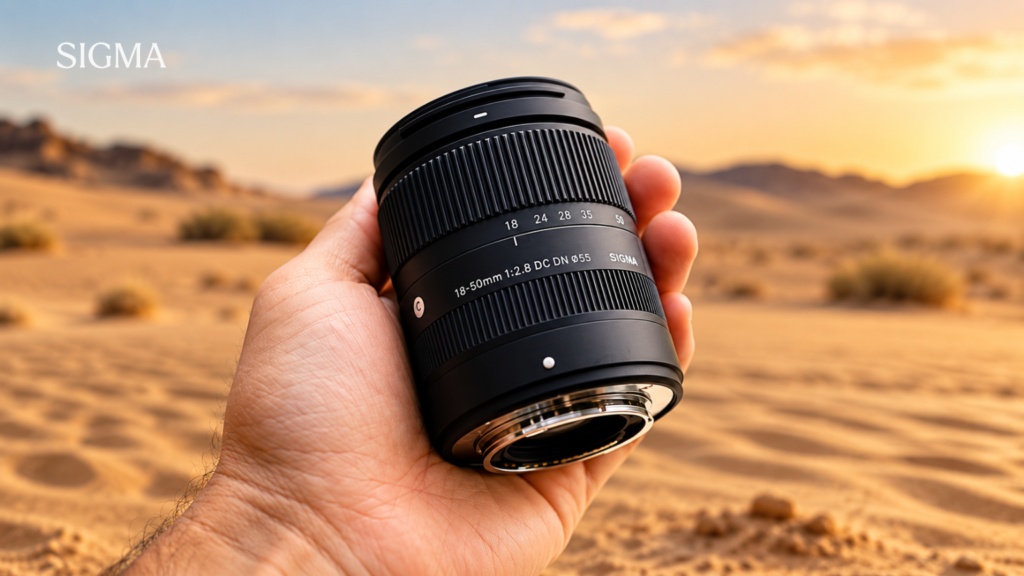
Sigma 18-50mm F2.8 DC DN Contemporary – Best All-Round Choice
For many Sony APS-C photographers, the Sigma 18-50mm F2.8 DC DN Contemporary is one of the most practical lenses to start with.
Its zoom range covers approximately 27-75mm in full-frame-equivalent terms, giving you wide, standard, and short-telephoto perspectives in one compact lens.
That makes it useful for:
- Travel photography
- Street photography
- Family photography
- Events
- Portraits
- Food and product photography
- YouTube videos
- Everyday photography
The constant F2.8 aperture is another important advantage.
Many standard kit zooms become slower as you zoom in. A constant F2.8 aperture gives you greater control in lower light and makes it easier to achieve background separation, particularly toward the longer end of the zoom range.
Who Should Buy the Sigma 18-50mm F2.8?
This lens makes sense for photographers who do not want to constantly change lenses.
If you own a Sony APS-C camera with a basic kit lens and want one meaningful upgrade, the 18-50mm F2.8 is an excellent place to start.
It is especially suitable for travel photographers and hybrid creators who regularly switch between photos and video.
Sigma 10-18mm F2.8 DC DN Contemporary – Best for Wide-Angle Photography and Video
Sometimes 18mm simply isn’t wide enough.
For landscapes, architecture, interiors, real estate, environmental videos, and handheld vlogging, a wider field of view can be extremely useful.
The Sigma 10-18mm F2.8 DC DN Contemporary provides approximately a 15-27mm equivalent field of view on Sony APS-C cameras.
This makes it particularly useful for:
- Landscape photography
- Architecture
- Interior photography
- Travel videos
- Vlogging
- Establishing shots
- Real estate photography
- Creative wide-angle compositions
The constant F2.8 aperture also gives creators more flexibility than a typical variable-aperture ultra-wide zoom.
Is 10mm Too Wide?
Not necessarily.
At 10mm, the lens provides a very broad perspective, which can be excellent when you are working in tight spaces or trying to capture a large scene.
However, photographers should pay attention to composition. With ultra-wide lenses, subjects close to the edges of the frame can appear stretched or exaggerated.
Used carefully, that wide perspective can become a creative advantage.
Sigma 16mm F1.4 DC DN Contemporary – Best for Low Light and Content Creation
The Sigma 16mm F1.4 DC DN Contemporary has long been one of the most recognizable Sigma APS-C prime lenses.
On a Sony APS-C camera, it provides approximately a 24mm-equivalent field of view.
That makes it wide enough for environmental photography while still being useful for people, video, and general content creation.
Its major attraction is the F1.4 maximum aperture.
Compared with slower kit lenses, F1.4 allows significantly more light into the camera. This can be helpful for indoor shoots, evening photography, restaurants, events, and other situations where available light is limited.
The wide aperture also provides greater control over depth of field.
Best Uses for the Sigma 16mm F1.4
This lens is particularly well suited to:
- YouTube videos
- Talking-head content
- Indoor photography
- Environmental portraits
- Street photography
- Night photography
- Travel
- Lifestyle content
Creators recording themselves can also appreciate the relatively wide field of view, although the ideal framing will depend on camera distance and whether additional digital stabilization crops the image.
Sigma 23mm F1.4 DC DN Contemporary – Excellent for Street and Everyday Photography
Photographers who prefer a natural-looking everyday perspective should consider the Sigma 23mm F1.4 DC DN Contemporary.
On Sony APS-C, 23mm gives approximately a 35mm-equivalent field of view.
The 35mm perspective has traditionally been popular for documentary, street, travel, lifestyle, and environmental portrait photography because it can include enough of the surrounding environment without feeling excessively wide.
This makes the Sigma 23mm F1.4 a strong option for photographers who like to tell a story around their subject.
Where Does the 23mm F1.4 Work Best?
Consider it for:
- Street photography
- Travel
- Lifestyle photography
- Environmental portraits
- Café and restaurant photography
- Documentary work
- Everyday family photography
- Low-light photography
The F1.4 aperture also makes it useful after sunset or inside locations where available light is limited.
For someone who wants to walk around with one prime lens and photograph everyday life, 23mm can be a very comfortable focal length.
Sigma 30mm F1.4 DC DN Contemporary – Best Everyday Prime
The Sigma 30mm F1.4 DC DN Contemporary sits between a wide environmental lens and a traditional portrait lens.
On Sony APS-C, its field of view is approximately equivalent to 45mm on full frame.
That is close to the classic “normal” perspective many photographers enjoy for everyday photography.
It works particularly well for:
- Everyday photography
- Portraits
- Street photography
- Food photography
- Product photography
- Indoor photography
- Lifestyle content
- Video
The F1.4 aperture allows photographers to isolate subjects more effectively than they generally can with an entry-level kit zoom.
Sigma 23mm vs 30mm: Which Should You Choose?
This is an important decision for APS-C photographers.
Choose the 23mm F1.4 if you prefer including more environment around your subject.
Choose the 30mm F1.4 if you prefer tighter framing and a more neutral perspective.
For street and travel photography, 23mm may feel more flexible. For portraits, products, food, and everyday subject-focused photography, 30mm can be particularly appealing.
Sigma 56mm F1.4 DC DN Contemporary – Best Sigma Portrait Lens for Sony APS-C
If portraits are your priority, the Sigma 56mm F1.4 DC DN Contemporary deserves serious consideration.
On Sony APS-C cameras, it provides an approximately 84mm-equivalent field of view.
That places it close to the classic short-telephoto range commonly associated with portrait photography.
The combination of this focal length and an F1.4 maximum aperture makes it possible to separate a person from the background effectively when shooting at appropriate distances.
It is excellent for:
- Portrait photography
- Fashion photography
- Wedding portraits
- Couple shoots
- Beauty photography
- Indoor portraits
- Detail photography
- Short telephoto video shots
Why 56mm Works So Well for Portraits
A longer focal length allows photographers to stand farther away from their subject while maintaining tight framing.
This often produces a flattering perspective for headshots and upper-body portraits.
At wider apertures, the lens can also produce a shallow depth of field, helping keep attention on the subject while rendering the background less prominently.
For photographers in Bangladesh working with weddings, fashion, personal portraits, or social media campaigns, this can be an especially useful lens.
Which Sigma Lens Is Best for Vlogging?
For handheld or desk-based vlogging, wider lenses usually make more sense because the camera is positioned relatively close to the creator.
Two particularly relevant choices are:
Sigma 10-18mm F2.8 DC DN Contemporary – Better when you need an ultra-wide field of view, especially for handheld filming or small rooms.
Sigma 16mm F1.4 DC DN Contemporary – Better when you want a brighter aperture, stronger low-light capability, and greater depth-of-field control.
Your choice should depend on your shooting distance.
If the camera will regularly be close to your face, the 10-18mm offers more framing flexibility. If you have enough room to position the camera farther away, the 16mm F1.4 can provide a particularly attractive look.
Which Sigma Lens Is Best for Wedding Photography?
Wedding photographers usually need more than one focal length because a wedding involves very different situations.
For wider scenes, group photographs, and venue coverage, the Sigma 18-50mm F2.8 provides useful flexibility.
For portraits and couple sessions, the Sigma 56mm F1.4 offers a more portrait-oriented perspective.
A photographer working with two camera bodies could potentially use a wider zoom or prime on one body and the 56mm on the other.
However, photographers should always consider venue size and working distance before choosing a lens. A 56mm lens can feel restrictive in a small room, whereas an 18-50mm zoom provides more freedom when movement is limited.
Best Sigma Lens for Travel Photography in Bangladesh
Travel photographers often prioritize portability and versatility.
For that reason, the Sigma 18-50mm F2.8 DC DN Contemporary is arguably the most practical option for a single-lens travel setup.
Its range can cover landscapes at the wider end, everyday scenes around the middle, and tighter details or portraits toward 50mm.
Photographers who prioritize landscapes and architecture could instead pair the 10-18mm F2.8 with the 18-50mm F2.8.
Together, these lenses cover a broad range from 10mm through 50mm while maintaining a constant F2.8 maximum aperture.
For photographers who prefer primes, a 23mm F1.4 can make an excellent compact everyday travel setup.
Prime Lens or Zoom Lens for Sony APS-C?
Both have advantages.
A zoom lens gives you flexibility. Instead of physically moving every time you need different framing, you can adjust the focal length.
This is particularly useful for:
- Events
- Travel
- Weddings
- Documentary work
- Fast-moving situations
A prime lens has one fixed focal length but can offer a brighter maximum aperture.
Sigma’s F1.4 APS-C primes are particularly attractive when photographers prioritize:
- Low-light shooting
- Subject separation
- Portraits
- Creative depth of field
- Compact single-focal-length setups
There is no requirement to choose only one type.
Many photographers use an F2.8 zoom for general work and add an F1.4 prime for situations where they need extra light or a shallower depth of field.
Best Sigma Lens for Beginners Using Sony APS-C
For most beginners, the Sigma 18-50mm F2.8 DC DN Contemporary provides the easiest starting point.
Why?
Because beginners are often still discovering what they enjoy photographing.
A zoom covering 18-50mm allows you to experiment with wide scenes, everyday perspectives, portraits, food, travel, and video without immediately buying several lenses.
After using it for some time, check which focal lengths you use most frequently.
If most of your favorite photographs are taken near the wide end, consider adding a 16mm or 23mm prime.
If you constantly shoot near 50mm and enjoy portraits, the 56mm F1.4 may be the more useful next purchase.
This approach helps you build a lens kit around your actual photography habits rather than specifications alone.
Quick Sigma Lens Recommendations for Sony APS-C
Here is a simple way to narrow down your options:
| Photography / Video Need | Sigma Lens to Consider |
|---|---|
| Everyday Photography | Sigma 18-50mm F2.8 |
| Travel Photography | Sigma 18-50mm F2.8 |
| Landscape Photography | Sigma 10-18mm F2.8 |
| Architecture & Interiors | Sigma 10-18mm F2.8 |
| Vlogging | Sigma 10-18mm F2.8 / 16mm F1.4 |
| Low-Light Photography | Sigma 16mm, 23mm, 30mm or 56mm F1.4 |
| Street Photography | Sigma 23mm F1.4 |
| General-Purpose Prime | Sigma 30mm F1.4 |
| Portrait Photography | Sigma 56mm F1.4 |
| Weddings & Events | Sigma 18-50mm F2.8 + 56mm F1.4 |
| Video Creation | Sigma 10-18mm F2.8 / 18-50mm F2.8 |
What to Check Before Buying a Sigma Lens in Bangladesh
Before purchasing, confirm that you are buying the correct Sony E-mount version of the lens.
Sigma produces some lens models for multiple mirrorless mounts, so the same lens name may be available with different mounts.
You should also consider:
Your camera model: Confirm compatibility with your specific Sony APS-C camera.
Your primary use: A portrait photographer and a vlogger need very different focal lengths.
Working distance: Longer lenses require more space between you and your subject.
Low-light requirements: If you frequently photograph indoors or at night, an F1.4 prime may be particularly useful.
Zoom flexibility: For events, travel, or rapidly changing situations, a zoom may be more practical than repeatedly changing primes.
Authenticity and warranty: Camera lenses are long-term purchases. Buy from a reliable source and confirm the product’s authenticity and applicable warranty conditions before purchasing.
Frequently Asked Questions
There is no single best lens for every photographer. The Sigma 18-50mm F2.8 is one of the most versatile options for general photography, while Sigma’s F1.4 primes are better suited to photographers who prioritize low light and shallow depth of field.
The Sigma 56mm F1.4 DC DN Contemporary is particularly well suited to portrait photography because its field of view on APS-C is approximately equivalent to 84mm on full frame.
Yes. Its versatile focal range and constant F2.8 aperture make it useful for learning different styles of photography without needing several lenses immediately.
Yes. Its relatively wide field of view and bright F1.4 aperture make it useful for content creation, indoor video, talking-head setups, and other video applications where the shooting distance is suitable.
The Sigma 23mm F1.4 is an excellent street-photography option because it gives approximately a 35mm-equivalent field of view on Sony APS-C cameras. The 30mm F1.4 is another good choice for photographers who prefer slightly tighter compositions.
Final Thoughts
The best Sigma lens for your Sony APS-C camera depends much more on how you shoot than on which lens has the most impressive specification sheet.
For photographers who need maximum versatility, the Sigma 18-50mm F2.8 DC DN Contemporary provides a practical balance of focal range, aperture, and portability.
For landscapes, architecture, interiors, and wide-angle video, the Sigma 10-18mm F2.8 DC DN Contemporary provides the wider perspective those subjects require.
Creators and low-light photographers can consider the Sigma 16mm F1.4, while street and everyday photographers may prefer the natural perspective of the Sigma 23mm F1.4 or 30mm F1.4.
And for photographers primarily interested in portraits, the Sigma 56mm F1.4 DC DN Contemporary provides a highly useful short-telephoto perspective on Sony APS-C cameras.
Instead of building a large lens collection immediately, start with the lens that matches the photography you do most often. As your experience grows, add focal lengths that solve genuine limitations in your existing setup.
For Sony APS-C photographers and creators in Bangladesh, Sigma’s APS-C lineup provides enough variety to build anything from a lightweight one-lens travel kit to a versatile photography and video system.
