
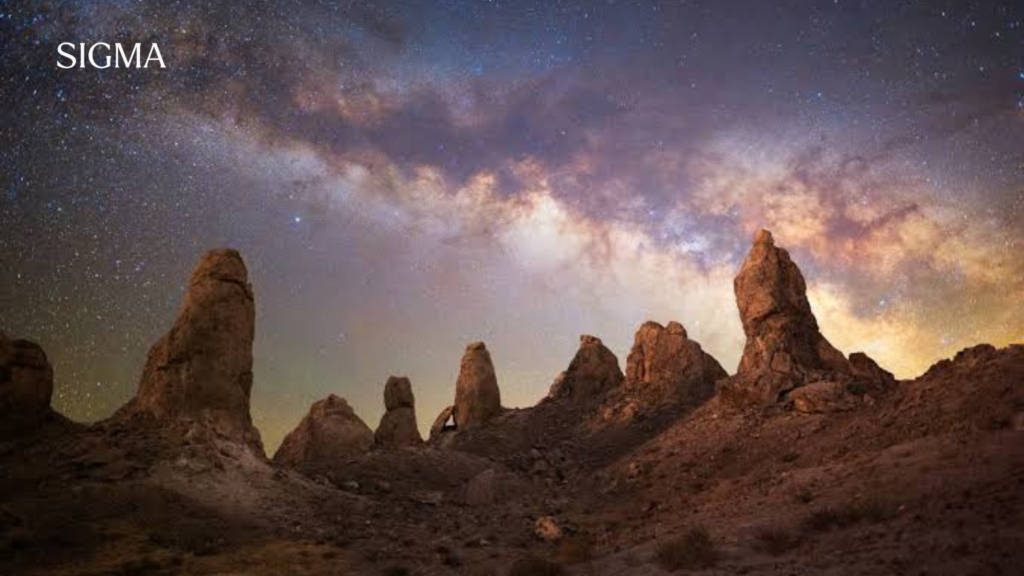
Astrophotography is one of the most challenging yet rewarding forms of photography. Capturing the Milky Way, star-filled skies, constellations and dramatic night landscapes requires more than simply pointing a camera upward.
The lens plays a major role in how much light your camera captures, how much of the sky fits inside the frame and how sharp stars appear near the edges of the image.
For photographers in Bangladesh, Sigma offers several wide-angle and large-aperture lenses that are particularly suitable for night sky photography.
From photographing stars over rural landscapes to creating Milky Way compositions away from the bright lights of Dhaka, choosing the right lens can dramatically improve the quality of your images.
This guide covers the best Sigma lenses for astrophotography in Bangladesh, including options for full-frame and APS-C mirrorless cameras.
What Makes a Lens Good for Astrophotography?
Astrophotography places different demands on a lens compared with everyday photography.
The night sky is extremely dark, and stars are small points of light. Your lens therefore needs to gather as much light as possible while maintaining good sharpness across the frame.
Several features matter most.
Wide Maximum Aperture
A large aperture such as F1.4 or F2.8 allows more light to reach the camera sensor.
This helps photographers capture brighter stars without relying on extremely high ISO settings or excessively long exposures.
For this reason, fast prime lenses are especially popular for Milky Way and star photography.
Wide Field of View
Wide-angle lenses allow photographers to include more of the sky together with the foreground.
This is important when photographing:
- The Milky Way
- Star fields
- Night landscapes
- Mountains
- Beaches
- Architecture under the night sky
- Rural landscapes
A wide lens also allows slightly longer shutter speeds before star movement becomes visible.
Good Corner Sharpness
Stars near the edges of the image can reveal optical problems very quickly.
A good astrophotography lens should maintain strong sharpness across the frame and control aberrations that can make stars look stretched or distorted.
Manual Focus Control
Most astrophotographers use manual focus because autofocus may struggle in extremely dark conditions.
A lens with precise manual focus control makes it easier to focus accurately on distant stars.
Best Sigma Lenses for Astrophotography in Bangladesh
1. Sigma 14mm F1.4 DG DN Art – Best Overall Sigma Lens for Astrophotography
For serious full-frame astrophotography, the Sigma 14mm F1.4 DG DN Art is one of the strongest Sigma options available.
Its combination of an ultra-wide 14mm focal length and extremely bright F1.4 aperture makes it particularly well suited to photographing large sections of the night sky.
The wide field of view allows photographers to include both dramatic foreground elements and a large area of stars.
This can be useful when photographing:
- Milky Way landscapes
- Star fields
- Night architecture
- Seaside night scenes
- Mountains and hills
- Rural landscapes
The F1.4 aperture is particularly important because astrophotography depends heavily on light gathering.
Opening the lens to F1.4 allows more light to reach the sensor, which can help photographers capture more visible stars while keeping shutter speeds relatively short.
Sigma also equips this lens with features designed with night photographers in mind, including a Manual Focus Lock switch and Lens Heater Retainer.
Why the Sigma 14mm F1.4 Is Excellent for Milky Way Photography
At 14mm, you can photograph a very large section of the sky.
This gives you more freedom when composing the Milky Way together with an interesting foreground.
The combination of ultra-wide framing and F1.4 light gathering makes this lens particularly attractive for experienced astrophotographers.
Best for: Milky Way photography, professional astrophotography, night landscapes, star fields and full-frame cameras.
View Product: Sigma 14mm F1.4 DG DN Art
2. Sigma 20mm F1.4 DG DN Art – Best Balanced Astrophotography Prime
The Sigma 20mm F1.4 DG DN Art is another excellent choice for astrophotographers using full-frame mirrorless cameras.
It is slightly less wide than the 14mm, but the 20mm focal length remains wide enough for impressive Milky Way landscapes while providing a more natural-looking perspective.
This makes it particularly useful if you want the night sky to appear large without making foreground objects look excessively distant.
The F1.4 aperture provides strong low-light performance.
It allows photographers to gather substantial amounts of light during relatively short exposures, helping reduce visible star trails.
Sigma specifically highlights the optical performance of this lens for astrophotography, and it also includes features useful for night shooting such as a Manual Focus Lock switch and Lens Heater Retainer.
Why Choose 20mm Instead of 14mm?
The choice depends on how you compose.
A 14mm lens captures a very wide section of the landscape and sky.
A 20mm lens provides a slightly tighter composition, which can make the Milky Way appear more prominent in the final image.
This makes the 20mm F1.4 an excellent balance between wide perspective and strong night-sky detail.
Best for: Milky Way photography, night landscapes, stars, full-frame mirrorless cameras and photographers who prefer a moderately wide perspective.
View Product: Sigma 20mm F1.4 DG DN Art
3. Sigma 24mm F1.4 DG DN Art – Best for Detailed Milky Way Compositions
Photographers who want a slightly tighter night-sky composition should consider the Sigma 24mm F1.4 DG DN Art.
The 24mm focal length is widely used in landscape and astrophotography because it provides enough width for environmental scenes without making the sky feel too distant.
It works particularly well when you want the Milky Way to become a stronger visual element in the photograph.
For example, instead of showing an enormous area of empty sky, you can create a composition where the Milky Way occupies a larger portion of the frame.
Its F1.4 aperture is also highly valuable for low-light photography.
This makes the lens useful for:
- Milky Way photography
- Star photography
- Night landscapes
- Astrophotography panoramas
- Low-light environmental photography
When Is 24mm Better for Astrophotography?
A 24mm lens works best when you already have enough space to compose and want a more focused view.
It can produce dramatic images where stars and the Milky Way appear larger relative to the foreground.
It is also a good option for photographers who want one fast prime that can be used for both astrophotography and everyday low-light photography.
Best for: Detailed Milky Way photography, night landscapes, panoramic astrophotography and low-light photography.
View Product: Sigma 24mm F1.4 DG DN Art
4. Sigma 16mm F1.4 DC DN Contemporary – Best APS-C Astrophotography Lens
APS-C photographers do not need to move to full frame to begin photographing the night sky.
The Sigma 16mm F1.4 DC DN Contemporary is one of the most practical Sigma options for APS-C mirrorless users interested in astrophotography.
Its wide focal length allows photographers to capture landscapes together with large areas of the sky.
More importantly, its F1.4 maximum aperture provides excellent light-gathering capability for an APS-C lens.
This can be extremely helpful when photographing stars in rural Bangladesh where artificial lighting is minimal.
The lens can also serve several other purposes during the daytime, including:
- Landscape photography
- Travel photography
- Architecture
- Vlogging
- Environmental photography
That versatility makes it particularly attractive to photographers who want one wide prime for both day and night photography.
Why It Works Well for Beginners
Astrophotography can become expensive quickly.
The Sigma 16mm F1.4 provides photographers with access to a fast, wide lens without necessarily requiring a full-frame camera system.
That makes it a strong entry point for photographers learning how to photograph stars and the Milky Way.
Best for: APS-C astrophotography, beginner night-sky photography, landscapes, travel and low-light photography.
View Product: Sigma 16mm F1.4 DC DN Contemporary
5. Sigma 10-18mm F2.8 DC DN Contemporary – Best APS-C Wide Zoom for Night Landscapes
Not every astrophotographer wants to work with a fixed focal length.
The Sigma 10-18mm F2.8 DC DN Contemporary gives APS-C photographers much more framing flexibility.
At 10mm, the lens can capture an extremely wide field of view.
This is useful for including dramatic foreground elements together with a large section of the sky.
Zooming toward 18mm provides tighter framing when you want the Milky Way or a foreground object to occupy more of the image.
The constant F2.8 aperture is slower than an F1.4 prime, but it remains bright enough for many night photography situations when paired with an appropriate ISO and shutter speed.
Why Choose an Ultra-Wide Zoom?
Astrophotography often requires careful composition.
The ability to adjust focal length allows you to change the relationship between the foreground and the night sky without constantly repositioning the tripod.
This flexibility also makes the lens useful for:
- Landscape photography
- Architecture
- Travel
- Interior photography
- Video
Best for: APS-C night landscapes, ultra-wide Milky Way compositions, travel and photographers who prefer zoom flexibility.
View Product: Sigma 10-18mm F2.8 DC DN Contemporary
6. Sigma 16-28mm F2.8 DG DN Contemporary – Best Full-Frame Astrophotography Zoom
Full-frame photographers who want flexibility rather than a fixed focal length should consider the Sigma 16-28mm F2.8 DG DN Contemporary.
Its focal range covers several useful astrophotography perspectives.
At 16mm, photographers can capture extremely wide night landscapes.
Around 20mm, the composition becomes more balanced for Milky Way photography.
At 24mm to 28mm, photographers can create tighter compositions where the night sky appears more dominant.
The constant F2.8 aperture means exposure remains consistent while zooming.
Although an F1.4 prime captures more light, the flexibility of a zoom can be more useful when photographing different landscapes during the same trip.
Best for: Full-frame night landscapes, Milky Way photography, travel and photographers who want one versatile wide-angle zoom.
View Product: Sigma 16-28mm F2.8 DG DN Contemporary
Quick Comparison: Best Sigma Astrophotography Lenses
| SIGMA Lens | Sensor Format | Maximum Aperture | Best For |
|---|---|---|---|
| SIGMA 14mm F1.4 DG DN Art | Full-frame | f/1.4 | Professional Milky Way photography |
| SIGMA 20mm F1.4 DG DN Art | Full-frame | f/1.4 | Balanced night-sky compositions |
| SIGMA 24mm F1.4 DG DN Art | Full-frame | f/1.4 | Detailed Milky Way compositions |
| SIGMA 16mm F1.4 DC DN Contemporary | APS-C | f/1.4 | APS-C astrophotography |
| SIGMA 10-18mm F2.8 DC DN Contemporary | APS-C | f/2.8 | Ultra-wide night landscapes |
| SIGMA 16-28mm F2.8 DG DN Contemporary | Full-frame | f/2.8 | Flexible full-frame night photography |
Best Sigma Lens for Milky Way Photography
If Milky Way photography is your main priority, lens choice should focus on two characteristics: width and aperture.
For full-frame cameras, the Sigma 14mm F1.4 DG DN Art is the strongest option if you want the widest possible composition combined with F1.4 light gathering.
The Sigma 20mm F1.4 DG DN Art is ideal if you want the Milky Way to occupy more of the image while still retaining a wide landscape perspective.
The Sigma 24mm F1.4 DG DN Art works particularly well for photographers who prefer tighter Milky Way compositions or stitched panoramas.
APS-C users should consider the Sigma 16mm F1.4 DC DN Contemporary.
Best Places and Conditions for Astrophotography in Bangladesh
Light pollution is one of the biggest challenges for astrophotographers.
Large cities such as Dhaka and Chattogram produce significant artificial light, which can reduce the visibility of faint stars.
For better results, photographers should look for locations away from dense urban lighting.
Rural landscapes, coastal regions and less-developed areas can provide darker skies when weather conditions are suitable.
Choose a Dark Location
The farther you move away from major artificial light sources, the easier it becomes to photograph faint stars.
Check the Moon
A bright moon can wash out much of the night sky.
Photographers trying to capture the Milky Way generally benefit from shooting when moonlight is limited or when the moon is below the horizon.
Watch the Weather
Clouds can completely cover the stars.
Clear skies and lower atmospheric haze provide better visibility.
Bangladesh’s weather can change quickly, so planning ahead is important.
Best Camera Settings for Astrophotography
Exact settings depend on the camera, lens and sky conditions, but these settings provide a useful starting point.
Shoot in Manual Mode
Manual mode gives you complete control over aperture, shutter speed and ISO.
Astrophotography usually requires more consistent exposure settings than automatic camera modes provide.
Use a Wide Aperture
With lenses such as the Sigma 14mm F1.4, 20mm F1.4 or 16mm F1.4, start near the widest aperture.
If stars near the edges do not look ideal, stopping down slightly may improve image quality.
Use a High ISO Carefully
ISO settings such as ISO 1600 to ISO 6400 are commonly used depending on the camera and available light.
Higher ISO makes stars brighter but also introduces more noise.
The goal is to find a balance.
Avoid Excessively Long Exposures
The Earth is constantly rotating.
If the exposure becomes too long, stars begin to appear as small lines instead of points.
Wide-angle lenses generally allow longer exposures than telephoto lenses before this effect becomes obvious.
Focus Manually
Autofocus can struggle in darkness.
Switch to manual focus, magnify a bright star or distant light on the camera screen and adjust focus until the point appears as small and sharp as possible.
Prime vs Zoom Lens for Astrophotography
Why Choose an F1.4 Prime?
Fast primes such as the Sigma 14mm F1.4, 20mm F1.4, 24mm F1.4 and 16mm F1.4 allow significantly more light to reach the sensor.
Advantages include:
- Better low-light performance
- Lower ISO possibilities
- Shorter exposure times
- Strong star visibility
- Excellent night landscape capability
Prime lenses are usually the preferred option when maximum night-sky performance is the priority.
Why Choose an F2.8 Zoom?
Zoom lenses such as the Sigma 10-18mm F2.8 DC DN and Sigma 16-28mm F2.8 DG DN provide more compositional freedom.
Advantages include:
- Multiple focal lengths
- Easier foreground framing
- Less lens changing at night
- Better flexibility for travel
- Useful for daytime landscapes as well
If versatility matters more than maximum light gathering, an F2.8 zoom can be a practical choice.
Essential Gear for Night Sky Photography
A good lens is only one part of an astrophotography setup.
Tripod
A stable tripod is essential because night-sky photography requires exposures lasting several seconds.
Remote Shutter or Self-Timer
Pressing the shutter button can create vibration.
Use a remote release or your camera’s two-second timer.
Extra Batteries
Long exposures and cold outdoor conditions can drain batteries faster than normal photography.
Carry at least one spare.
Lens Cloth
Humidity or condensation can form on the front element during long night sessions.
A clean microfiber cloth is useful.
Which Sigma Astrophotography Lens Should You Buy?
Best Overall
Choose the Sigma 14mm F1.4 DG DN Art if maximum full-frame astrophotography performance and an ultra-wide perspective are your priorities.
Best Balanced Full-Frame Prime
Choose the Sigma 20mm F1.4 DG DN Art if you want a natural balance between wide landscapes and prominent Milky Way detail.
Best for Tighter Milky Way Photography
Choose the Sigma 24mm F1.4 DG DN Art if you prefer more focused compositions or astrophotography panoramas.
Best APS-C Prime
Choose the Sigma 16mm F1.4 DC DN Contemporary if you use an APS-C mirrorless camera and want strong low-light capability.
Best APS-C Zoom
Choose the Sigma 10-18mm F2.8 DC DN Contemporary if ultra-wide framing flexibility is more important than an F1.4 aperture.
Best Full-Frame Zoom
Choose the Sigma 16-28mm F2.8 DG DN Contemporary if you want one versatile wide-angle lens for astrophotography, landscapes and travel.
Frequently Asked Questions
The Sigma 14mm F1.4 DG DN Art is one of the strongest choices for full-frame astrophotography because it combines an ultra-wide 14mm focal length with an F1.4 aperture.
The Sigma 14mm F1.4 and Sigma 20mm F1.4 DG DN Art are excellent choices. The 14mm captures a wider portion of the sky, while the 20mm makes the Milky Way appear more prominent.
Yes. F1.4 allows a large amount of light to reach the camera sensor, making it extremely useful for stars and Milky Way photography.
Yes. The Sigma 16mm F1.4 DC DN Contemporary is an excellent option for APS-C mirrorless photographers because it provides both a wide field of view and a bright aperture.
Yes. F2.8 lenses can produce excellent astrophotography results, particularly with modern cameras and darker skies. However, an F1.4 lens gathers more light and can provide greater exposure flexibility.
Choose 14mm when you want an extremely wide composition that includes a large area of sky and foreground.
Choose 20mm when you want the Milky Way to appear larger and more dominant within the composition.
Light pollution makes Milky Way photography difficult inside heavily illuminated urban areas. Traveling away from major city lights generally provides significantly better visibility.
Photographers can explore compatible Sigma lenses through Sigma Photo Bangladesh and confirm the appropriate camera mount before purchasing.
Final Thoughts
Choosing the best Sigma lenses for astrophotography in Bangladesh depends on your camera format, budget and preferred night-sky composition.
For photographers seeking the strongest full-frame astrophotography option, the Sigma 14mm F1.4 DG DN Art combines an ultra-wide perspective with outstanding F1.4 light gathering.
The Sigma 20mm F1.4 DG DN Art provides a more balanced perspective, while the Sigma 24mm F1.4 DG DN Art is ideal for tighter Milky Way compositions.
APS-C photographers can achieve impressive night-sky results with the Sigma 16mm F1.4 DC DN Contemporary, while the Sigma 10-18mm F2.8 DC DN Contemporary provides valuable zoom flexibility.
For full-frame photographers who prefer a zoom, the Sigma 16-28mm F2.8 DG DN Contemporary is a versatile choice for stars, landscapes and travel photography.
With a stable tripod, careful manual focusing, dark skies and the right Sigma wide-angle lens, photographers across Bangladesh can create detailed photographs of the Milky Way, stars and night sky.
Explore Sigma lenses in Bangladesh and choose the lens that best matches your camera system and astrophotography style.
